

If your BOM has more than a few hundred lines, you already know the relief of 2024’s oversupply did not make component sourcing easy — it made it selective. Lead times on automotive-grade MCUs and power MOSFETs keep swinging between allocation and stock, gray-market activity rises every time a shortage makes headlines, and procurement teams are expected to deliver cost-down targets at the same time. This guide distills how experienced OEM and EMS buyers source electronic components in 2026: which channels to use, how to qualify a supplier, what documents to demand, and how to protect production when the market turns again.
The 2026 Sourcing Landscape: Selective Tightness, Not a Boom
The broad market is balanced, but tightness is concentrated in specific pockets: automotive and industrial silicon, wide-bandgap power devices, precision analog, and legacy MCUs whose fabs are being qualified out for newer nodes. For a buyer, this means the average lead time on your BOM can look healthy while three critical parts sit at 40+ weeks — and those three parts define your build plan.
Three structural shifts are here to stay:
- Regionalized supply chains. Tariff exposure and localization requirements push buyers toward distributors who can document origin and handle multi-region logistics.
- Stricter traceability demands. Automotive and medical customers increasingly require full chain-of-custody documentation, not just a COC on request.
- Faster EOL cycles. As vendors consolidate portfolios, parts are being discontinued sooner, making lifecycle monitoring a continuous task rather than a yearly review.
A 7-Step Framework for Sourcing Components
1. Build an Approved-Vendor Matrix Before You Need It
The worst time to qualify a new supplier is the week you are out of stock. Maintain a living matrix of approved sources — franchised distributors, qualified independent distributors, and brokers you have used for spot buys — with each one’s strengths, payment terms, and quality certifications on record. When a shortage hits, you execute against the matrix instead of cold-calling Google results.
2. Validate Part Data at the Source
Before requesting a quote, confirm you are quoting the right part: full manufacturer part number with package and temperature suffix, current datasheet revision, and package code. A surprising share of sourcing delays trace back to RFQs for “LM358” when the design actually needs the LM358DRG4 in tape and reel. Cross-reference the part against the manufacturer’s official product page, not just a marketplace listing.
3. Diversify Channels Deliberately
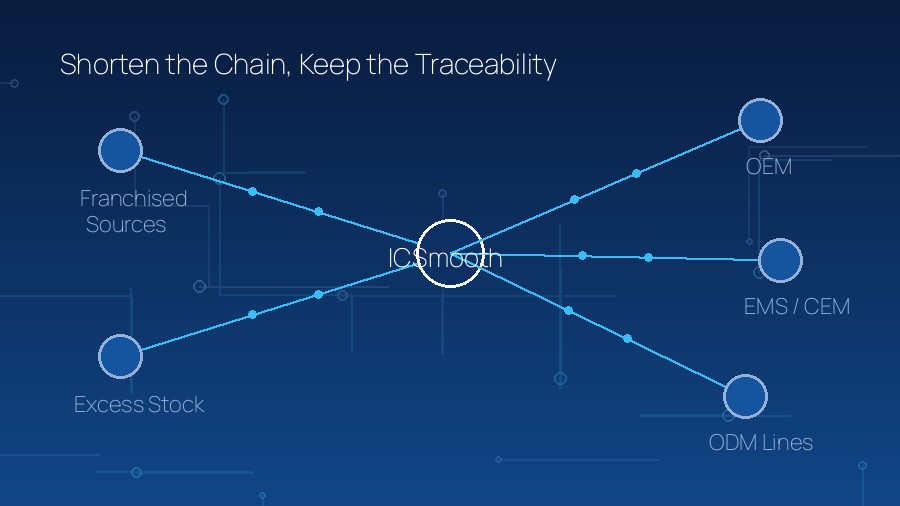
Franchised distribution covers your planned demand with contractual pricing. Independent distribution covers the gaps: allocation spikes, EOL last-time-buys, and excess inventory from other OEMs. Brokers are a last resort for true emergencies. The healthiest supply strategy uses all three deliberately — roughly 80–90% franchised for planned volume and 10–20% independent for flexibility, with broker activity kept exceptional and documented.
4. Qualify Independent Distributors on Evidence
Not all independent distributors are equal. A supplier worth putting on your AVL can show, on request:
- A documented counterfeit inspection process (external visual, marking permanence, electrical test, X-ray or decap where warranted), ideally aligned with IDEA-STD-1010 or AS6081 practices.
- Traceability documentation — chain of custody back to a franchised source, OCM/OEM excess, or a documented buying account.
- Test capability or partner lab with component engineering support, not just a trading desk.
- References and trading history in your industry vertical.
5. Manage Date-Code and Lifecycle Risk Actively
For most commercial parts, date code matters less than handling and moisture-sensitivity compliance — but for automotive, medical, and high-reliability programs, a two-year-old date code can fail incoming requirements outright. Track PCNs and EOL notices on every critical part; when a discontinuation lands, decide on last-time-buy, pin-compatible alternates, or emulation solutions within the vendor’s window, not after it.
6. Lock Pricing and Lead Times in Writing
Verbal quotes evaporate in a rising market. For scheduled demand, use blanket orders with release windows, or a pricing agreement with a validity period. For spot buys, get the order acknowledgment to state part number, quantity, date code range, country of origin, and delivery terms — discrepancies in an acknowledgment are your earliest and cheapest warning sign.
7. Keep a BOM Risk Dashboard
Once a month, score every critical part: sole-source? single-region fab? lead-time trend? EOL within 24 months? Parts that fail two or more checks deserve a mitigation plan — approved alternate, buffer stock, or second-source redesign. An hour of dashboard review routinely prevents weeks of line-down firefighting.
Franchised vs. Independent vs. Broker: When to Use Each
| Channel | Best For | Watch Out For |
|---|---|---|
| Franchised distributor | Planned production volume, new designs, technical support | Allocation during shortages; strict credit terms for new accounts |
| Independent distributor | Allocation gaps, EOL/last-time-buy, cost-down on stable parts | Quality varies widely — qualify on evidence, not price alone |
| Broker / open market | True line-down emergencies only | Highest counterfeit exposure; minimal recourse on bad product |
Counterfeit Defense: A Practical Checklist
Counterfeit components rarely announce themselves. The tells are procedural, and every one of them is checkable before you wire money:
- Price too far below market. A quote at 40% of franchised cost on an allocated part is not a bargain — it is a risk signal.
- Refusal to provide traceability. “Customer confidential” can be legitimate; “we don’t provide any documentation” never is.
- Inconsistent marking. Font mismatches, laser depth differences, or lot/date codes that don’t match the manufacturer’s scheme for that period.
- Packaging anomalies. Wrong reel leader/trailer, non-standard moisture-barrier bags, or labels with spelling drift from the OCM standard.
- Skipped incoming inspection. Even good suppliers’ product gets inspected on receipt at critical parts — make it policy, not exception.
Frequently Asked Questions
How many suppliers should I qualify per critical part?
At minimum two: one franchised (or the OCM direct for large volumes) and one qualified independent. For sole-sourced parts, add an approved broker relationship you have validated in calm market conditions.
Are independent distributors safe for automotive production?
They can be, when the distributor documents full traceability and testing, and your quality organization approves the process. The risk is not the channel itself — it is skipping the qualification you would apply to any other supplier.
What lead time should I plan for in 2026?
Treat any lead time over 16 weeks on a critical part as a planning constraint. Maintain rolling 12-month visibility with your distributor and revisit forecasts monthly — suppliers allocate to customers whose forecasts prove reliable.
When does an RFQ beat checking stock lists?
Always send the RFQ. Stock lists show what a distributor thinks it has; an RFQ with quantity, target price, and required date code gets you a committed answer with freshness — and for multi-line BOMs, a single sourcing partner can consolidate logistics and documentation.
Putting It Into Practice
Start small: pick the ten riskiest parts on your highest-volume BOM and run them through the seven steps above. Qualify one independent distributor properly — ask for the inspection process, the traceability paperwork, and references. Then upload your BOM or submit an RFQ and measure the response: committed quantities, documented date codes, and honest lead-time answers are what a professional sourcing partner looks like in any market cycle.
ICSmooth supplies authentic, traceable electronic components to OEM and EMS customers worldwide, with documented inspection processes and multi-channel sourcing across franchised and excess inventory. Submit an RFQ or browse our catalog to put this framework to work.


