

The 2026 semiconductor market is not tight or loose — it is two markets. On one side, AI infrastructure spending keeps pulling demand for high-bandwidth memory, dense DRAM, and high-end MLCC past the previous cycle’s ceiling. On the other, the consumer-electronics recovery is stuck, leaving mainstream memory and commodity MLCC oversupplied. For OEM and EMS buyers this is the most workable environment in years, provided you know which side of the divide each of your lines sits on.
The Background: AI Infrastructure Sets the Cycle
Three structural forces are doing the lifting on the demand side: hyperscaler capex on AI training and inference, sovereign AI infrastructure announcements across multiple regions, and continued retooling of edge AI in enterprise hardware. None of them are short-cycle: — they are multi-year programs with visibility through 2027 in the public roadmaps of the largest buyers. The passive and active components tied to AI servers — high-bandwidth memory stacks, server-grade DRAM, and the high-end MLCC that ride alongside accelerator boards — have moved into a structurally different demand regime from the consumer and PC channels that dominated the previous decade.
Three second-order effects matter for buyers outside the hyperscaler tier:
- Capacity reallocation. Leading memory and MLCC suppliers are visibly reallocating mature-node capacity toward AI-grade product, tightening the rest of the catalog.
- Allocation, not shortage. The market is not in panic-allocation; it is in selective allocation, where AI-priority parts run tight while PC-and-consumer parts run loose.
- Book-to-bill divergence. Vendors report contrasting book-to-bill between high-end lines (above parity, signaling tightening) and consumer lines (below parity, signaling slack).
Memory: HBM and Server DRAM Lead, NAND Splits, Consumer DRAM Softens
Inside the memory segment, the picture is sharply bifurcated. HBM — the stacked DRAM that feeds accelerator boards — is contracted out through 2027 in public statements from leading suppliers, and capacity expansion plans will not soften that posture inside the planning horizon most buyers care about. High-density server DRAM follows HBM in priority, with module-level demand firming for cloud and enterprise refreshes. Mainstream DDR4 and consumer DRAM, by contrast, are sitting on inventory built during the prior downturn and price-soft as a consequence. NAND splits similarly: enterprise SSD and high-endurance flash tighten with AI data-center demand, while client SSD and consumer NAND remain loose.
| Memory Segment | Demand Driver | Lead-Time Posture | Implication for Buyers |
|---|---|---|---|
| HBM and HBM-adjacent DRAM | AI training / inference accelerator boards | Firmly allocated, multi-quarter | Plan 12+ months ahead; engage early |
| High-density server DRAM | Cloud refresh, enterprise server build | Tightening | Lock pricing and release windows |
| Mainstream DDR4 / DDR5 | PC and mainstream server | Loose, inventory-rich | Spot buys favorable, but quality matters |
| Enterprise SSD / high-endurance NAND | AI data-center storage tier | Tightening | Forecast rolling 12-month visibility |
| Client SSD / consumer NAND | PC, smartphone, consumer device | Soft | Price-down opportunity; verify date codes |
MLCC: High-End Tightens, Consumer Stays Slack
The passive-component side echoes the active-side split. High-end MLCC — the small-case, high-capacitance, low-ESR parts that sit next to GPU and ASIC power stages — is the priority capacity at the major MLCC suppliers, with order books running above parity and reallocation of mature-node lines visibly underway. The consumer-grade MLCC market — the larger-case, general-purpose parts used in PC, white goods, and consumer electronics — remains slack, with capacity ample and pricing soft as the consumer recovery continues to undershoot expectations. The automotive MLCC segment sits in between: tight on AEC-Q200-qualified automotive-grade lines, normal on industrial-grade.
| MLCC Segment | Application | Book-to-Bill | Pricing Posture |
|---|---|---|---|
| High-end MLCC | AI server, accelerator power stage | Above 1 | Firming |
| Automotive MLCC | AEC-Q200 lines, EV / ADAS | At or above 1 | Stable to firming |
| Industrial-grade MLCC | Industrial, IoT, infrastructure | Around 1 | Stable |
| Consumer-grade MLCC | PC, smartphone, white goods | Below 1 | Soft |
What This Means for OEM and EMS Buyers
The 2026 market rewards buyers who segment their BOM rather than treating it as one number. A few practical moves go a long way:
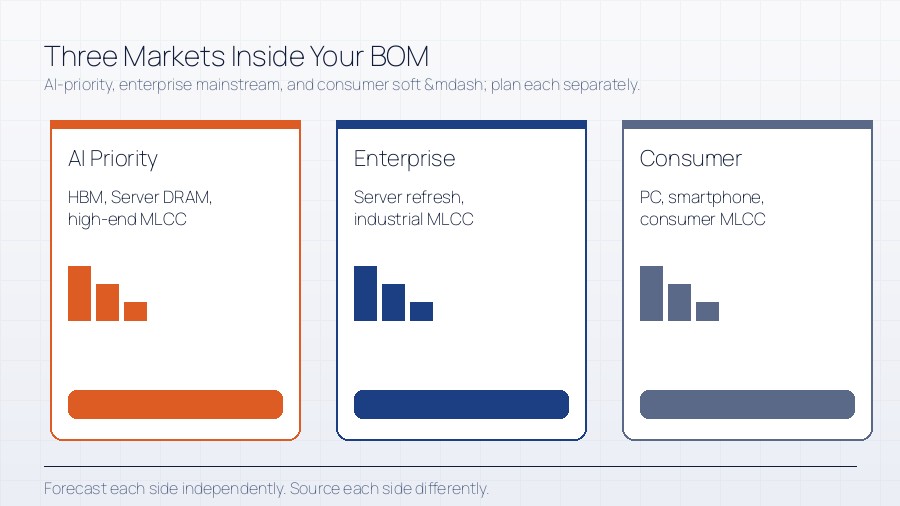
- Split BOM by demand regime. Tag each line as AI-side (HBM, high-density DRAM, high-end MLCC) or consumer-side (DDR4, client SSD, commodity MLCC). Forecast and source each bucket separately.
- Lock AI-side volume early. Multi-quarter release schedules and pricing agreements beat spot buys when the segment is allocated.
- Use the consumer-side softness. For non-critical lines, this is a cost-down window — but treat soft pricing as a quality-check trigger: a quote dramatically below market is a counterfeit risk signal, not a bargain.
- Watch the second-order squeeze. Capacity reallocation toward AI grades can tighten adjacent automotive and industrial lines. If your BOM straddles both sides, plan for it.
- Communicate forecasts suppliers can act on. Suppliers allocate to customers whose forecasts prove reliable. A rolling 12-month view beats a one-shot RFQ.
Frequently Asked Questions
How long will AI-driven demand stay this strong?
Public roadmaps from the largest AI infrastructure buyers suggest multi-year visibility, with allocations already committed through 2027 for the highest-priority parts. The upside question is whether sovereign and enterprise AI adds a second wave on top of hyperscaler capex; that is the main swing factor for the second half of the cycle.
If I am a small-volume buyer, do I even feel the AI side?
Indirectly, yes. Capacity moving to AI-priority parts tightens adjacent lines, including automotive and industrial grades that small-volume buyers depend on. You will feel it less in price and more in lead-time flexibility; the answer is to keep your approved-distributor matrix warm and your forecasts visible.
Will the consumer side turn around and pull prices up again?
Macro recovery in consumer electronics is the swing variable. Until it does, mainstream memory and commodity MLCC stay soft. The right posture is opportunistic cost-down on stable parts, not stockpiling — AI-side tightness does not extend into the consumer catalog.
How does this affect counterfeit and quality risk?
When a market splits, gray-market activity concentrates in the tight side. Treat AI-priority parts with the strictest inspection and traceability discipline; for the soft side, the risk is less counterfeiting than date-code drift and storage-condition lapses on inventory that has been sitting in the channel.
A Worked Example: Segmenting a Mixed BOM
Consider a 200-line board for an AI-adjacent edge device: one HBM-equipped accelerator socket, four high-density DRAM modules, twelve high-end MLCC near the power stage, twenty automotive-grade MLCC on the I/O section, and roughly 150 commodity MLCC and mainstream DDR lines in the rest of the design. In the 2026 market, the first three groups run on the AI-priority clock — they want 12-month rolling forecasts and locked release windows. The automotive-grade group sits in the firm-middle: tighten your approved-distributor matrix now, because automotive-grade is the segment most often squeezed by AI-side capacity reallocation. The remaining 150 lines are the cost-down opportunity: spot buys are favorable, but every lot still earns the same incoming-inspection discipline, because soft pricing in a split market is also when date-code drift and storage lapses creep into the channel.
Putting It Into Practice
Run your top three AI-tied lines through the high-end-supplier matrix first — HBM, high-density server DRAM, and the small-case high-capacitance MLCC on your accelerator or AI-server-adjacent boards. Lock release schedules and pricing now, before the next allocation round. For consumer-side lines, take the cost-down opportunity while keeping inspection discipline tight. Browse integrated circuits or circuit protection for current stock, or submit an RFQ with your AI-side and consumer-side lines and we will spec the sourcing plan to match the cycle.
ICSmooth supplies authentic memory, MLCC, and discrete components from leading manufacturers, with full traceability and dual-channel sourcing across franchised and excess inventory. Submit an RFQ or browse our catalog to align your BOM with the 2026 cycle.


