
For most of the last decade, supply chain conversations about leading-edge silicon started and ended at the wafer fab. The 2026 cycle is telling a different story: the bottleneck has migrated. As advanced-node wafer capacity finally catches up with demand in segments outside AI accelerators, the chokepoint has moved decisively into advanced packaging — the CoWoS, SiP, and chiplet interconnect lines that turn bare die into working modules. For OEM and EMS buyers this is the conversation to start having now, because the suppliers, qualification timelines, and capacity-allocation rules are not the same ones you used for silicon.
Why Packaging Became the Story
Three forces pushed advanced packaging from an engineering detail to a strategic concern. First, the AI accelerator market consolidated around architectures that depend on HBM stacked next to logic on a silicon interposer — a packaging-first design rather than a packaging-after-the-fact step. Second, the leading foundries and OSATs have prioritized advanced packaging capacity over additional logic-node capacity, meaning the gating line for many new designs is no longer the wafer but the interposer. Third, the rise of chiplet architectures across CPU, networking, and AI training silicon means more packages per system, with multiple OSATs and assemblers involved — and more places where capacity can tighten.
Three practical consequences for buyers:
- Allocation talks now include the package, not just the die. When you negotiate supply on AI silicon, the packaging line is part of the conversation.
- Second-source strategy has to extend to packaging. A pin-compatible second source for the die is meaningless if it is bonded at the same packaging line.
- Lead times for advanced-packaged parts decouple from wafer lead times. Treat them as a separate item in your forecast and your risk model.
The Advanced-Packaging Technologies in Use
| Technology | What It Does | Typical Application | Lead-Time Posture |
|---|---|---|---|
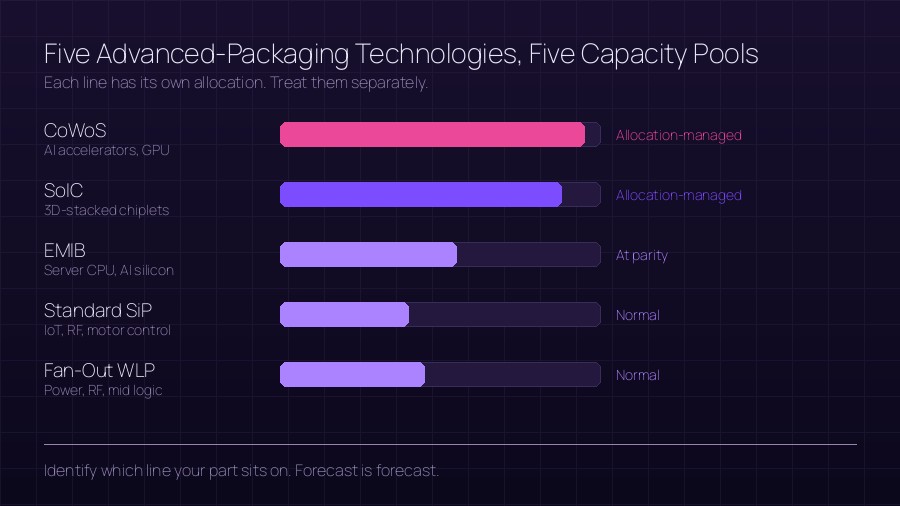
| CoWoS (Chip-on-Wafer-on-Substrate) | Logic and HBM stacked on a silicon interposer | AI accelerators, high-end GPU | Tight, allocation-managed |
| SoIC (System-on-Integrated-Chips) | 3D-stacked chiplets with through-silicon vias | Leading-edge logic, networking | Tightening |
| EMIB (Embedded Multi-die Interconnect Bridge) | Embedded silicon bridges in an organic substrate | Server CPU, AI silicon | At parity |
| Standard SiP (System-in-Package) | Multiple dies in one module, side-by-side | IoT, RF front-end, motor control | Normal |
| Fan-Out Wafer-Level Packaging | Die embedded in a reconstituted wafer, no substrate | Power management, RF, mid-range logic | Normal to tightening |
The Capacity Picture Behind the Lines
Advanced packaging capacity concentrates in a smaller number of suppliers than wafer capacity does. The leading foundry owns CoWoS and SoIC in-house, with capacity additions disclosed in capital plans that stretch over multi-year horizons. The OSAT ecosystem handles standard SiP, fan-out, and parts of the advanced-packaging mix, and capacity there is allocated among many customers on multi-quarter windows. Net result: when AI silicon demand rises, the limiting factor is rarely the wafer; it is the interposer line, the bonding tool, or the substrate capacity that supports the package.
For buyers outside the top-tier accelerator programs, the picture is uneven. Some advanced-packaging lines run tight because AI demand crowds out other uses; others run normal because the technology does not overlap with the AI segment. Knowing which line your part sits on, and how that line’s allocation is set, is the difference between a forecast you can plan against and a forecast you cannot.
What This Means for OEM and EMS Buyers
The procurement playbook for advanced-packaged parts has more steps than the one for mature-node packaged silicon. The work pays off:
- Identify the packaging line for each critical part. A part number tells you the die; you need the data sheet and your supplier to confirm the package family and packaging line.
- Forecast packaging capacity, not just wafer capacity. If your AI-adjacent design uses CoWoS or SoIC, packaging capacity is your real lead-time driver.
- Qualify a second source at the package level. For mature-node silicon, a pin-compatible alternative is usually enough. For advanced-packaged parts, the alternative needs the same package technology and the same qualified assembly line.
- Engage OSATs early, not late. OSAT capacity decisions are made on rolling windows. If you show up in the middle of a quarter, the line is full.
- Watch the second-order squeeze. As CoWoS and SoIC lines prioritize AI, the OSATs absorb more standard SiP and fan-out — which can tighten adjacent IoT and industrial designs.
Frequently Asked Questions
Is advanced-packaging allocation really tighter than wafer allocation?
For leading AI silicon on CoWoS or SoIC, yes — packaging capacity has been the binding constraint through recent cycles. For mature SiP and fan-out, allocation is more nuanced and depends on the supplier and the package size. Treat each line separately rather than assuming “advanced packaging” is a single uniform market.
Do I need to qualify a different supplier for the package and the die?
Usually no — the foundry that builds the die typically also handles CoWoS and SoIC, and the OSAT ecosystem handles the standard packages. The second-source question is whether the foundry’s alternative line uses the same packaging technology, which it may or may not. This is the conversation to have early, not after the design freeze.
How long are advanced-packaging qualification timelines?
They are longer than mature-package qualification because the assembly process is more sensitive to substrate, interposer, and bonding-tool variation. Budget more than the typical package-qualification window, and plan to lock the packaging supplier before the design freeze rather than after.
Is chiplet packaging a separate category from CoWoS?
It overlaps. Chiplet is the design approach; CoWoS, SoIC, and EMIB are among the packaging technologies that make chiplets work. The procurement implication is similar regardless: the bottleneck is the package, the second source has to match the package, and the timeline is longer than mature-node silicon.
A Worked Example: A Networking Module With Mixed Package Types
Consider a mid-volume networking line that mixes three silicon generations on one board: a leading-edge switch ASIC on CoWoS, a mainstream FPGA on standard SiP, and a power-management IC on a small fan-out wafer-level package. In a balanced market, the lead-time question is one BOM. In 2026, it is three different conversations. The CoWoS part runs on a constrained interposer line that the foundry allocates on multi-quarter windows, so the right move is to forecast and lock release schedules early. The FPGA on SiP runs at a standard OSAT line where lead times track more conventional logic packaging, and the forecast problem is more about wafer availability than packaging. The PMIC on fan-out is the easiest of the three but should not be ignored — when CoWoS lines prioritize AI, fan-out demand often gets pulled into the OSATs that the absorption split left slightly tighter. Three lines, three different supply conversations, one BOM dashboard.
Putting It Into Practice
Pick your three most packaging-sensitive parts — any design that uses HBM, any networking silicon that integrates multiple dies, any leading-edge processor module — and ask your supplier which packaging line they sit on. Treat that line as a separate risk item in your BOM dashboard, and engage your supplier partners on capacity before the design freeze rather than after. For advanced-packaged silicon and the surrounding power-management and interconnect parts, browse our integrated circuits catalog or submit an RFQ with your AI-adjacent lines and we will spec the package and the die together.
ICSmooth supplies authentic ICs, advanced-packaged silicon, and supporting components from leading manufacturers, with full traceability and dual-channel sourcing across franchised and excess inventory. Submit an RFQ or browse our catalog to align your packaging strategy with the 2026 supply chain.


